

Understanding the real impact of trade policy shifts is critical in today’s volatile global economy. If you’re searching for clear insight into trade liberalization long-term effects, this article is designed to give you exactly that—grounded analysis, forward-looking context, and practical implications for Asia-Pacific markets and beyond.
As supply chains recalibrate and new trade agreements reshape regional alliances, investors, policymakers, and business leaders alike need more than headlines. They need evidence-based interpretation of how tariff reductions, market access expansions, and regulatory harmonization influence growth, labor markets, capital flows, and currency stability over time.
This piece draws on comprehensive economic data, historical trade outcomes, and current Asia-Pacific policy developments to clarify what liberalization actually delivers—and where risks persist. You’ll gain a balanced view of structural gains, sectoral disruptions, and the broader macroeconomic trajectory, helping you make informed decisions in an increasingly interconnected global marketplace.
Open trade is often sold as a simple growth engine. In reality, it is an economic rewiring. When tariffs fall, capital and labor don’t just expand; they relocate. Former industrial hubs can hollow out, while logistics corridors and export clusters boom. That divergence is where most analyses stop.
Yet the deeper story lies in productivity spillovers, currency pressures, and policy feedback loops that unfold over decades. The trade liberalization long-term effects include wage polarization, supply-chain dependency, and innovation diffusion across borders.
Critics argue protection preserves stability. However, data from post-1990 Asia-Pacific reforms show productivity and income convergence (World Bank, 2020).
The Foundational Promise: Efficiency, Growth, and Consumer Gains
Revisiting Ricardo
David Ricardo’s theory of comparative advantage—the idea that countries should specialize in what they produce relatively more efficiently—forms the intellectual bedrock of free trade. Even if one nation is better at producing everything, gains arise when each focuses on its lowest opportunity cost. Think of Vietnam concentrating on electronics assembly while Australia leans into minerals (yes, even if both can technically do both). The principle is simple: specialize, trade, prosper.
Practical tip: Identify which sectors in your country consistently attract export demand and policy support; those often reflect comparative advantages in action.
The Macro-Level Boom
Data from the World Bank shows countries reducing tariffs since the 1990s have generally seen higher GDP growth and FDI inflows (World Bank, 2023). Critics argue correlation isn’t causation—and they’re right to question it. Yet repeated patterns across Asia-Pacific economies suggest trade liberalization long-term effects include expanded capital access and productivity spillovers.
The Consumer Dividend
Lower tariffs typically reduce import prices, increasing choice and competitive pressure. The result? More affordable smartphones, diverse food options, and faster innovation cycles (OECD, 2022).
The Engine of Specialization
Open markets channel resources into high-productivity sectors, improving global allocation efficiency. Step-by-step: reduce barriers, attract capital, reinvest in strengths, scale exports. It’s less dramatic than a blockbuster plot twist—but far more transformative.
The Unseen Balance Sheet: Sector Disruption and Labor Market Shifts
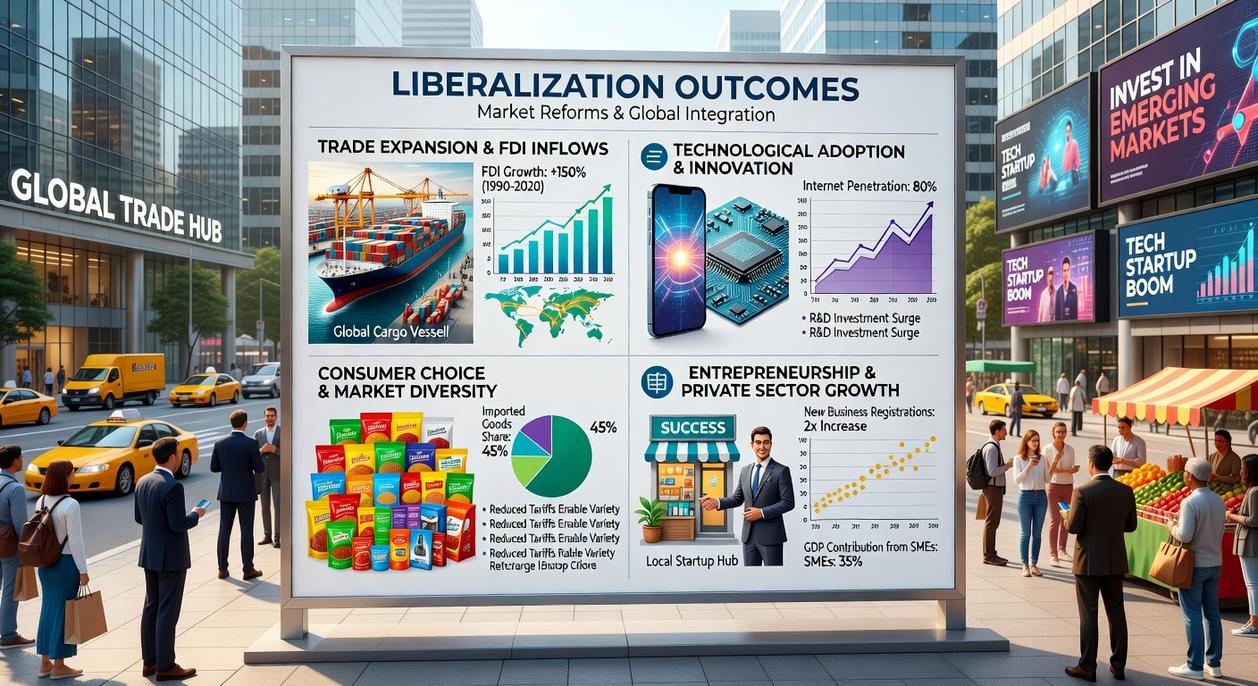
Trade liberalization promises growth, lower prices, and broader markets. And it often delivers. Consumers gain access to affordable goods, exporters tap new demand, and innovation accelerates. But behind the headline GDP gains lies a quieter ledger—one that records structural unemployment, wage pressure, and uneven opportunity.
Structural unemployment occurs when workers’ skills no longer match available jobs. When domestic manufacturing or textiles shrink under cheaper imports, entire communities can lose their economic anchor. The upside? Capital and labor eventually reallocate toward more competitive industries—technology, advanced services, renewable energy—where productivity and long-term earnings potential are higher (Autor, Dorn & Hanson, 2013).
Still, critics argue the trade liberalization long-term effects include wage stagnation for low-skilled workers. Research shows import competition has contributed to downward wage pressure in certain U.S. regions (Autor et al., 2016). Meanwhile, high-skilled workers and capital owners often capture disproportionate gains. That sounds bleak. Yet understanding this imbalance helps policymakers design smarter tax credits, mobility grants, and wage insurance programs—tools that can spread benefits more evenly.
The challenge? Re-skilling moves slower than markets. Government retraining initiatives frequently struggle with completion rates and job placement alignment (GAO, 2019). But when programs partner directly with growing industries, outcomes improve dramatically (OECD, 2020). (Turns out, training someone for a job that actually exists helps.)
Consider the Rust Belt. Rapid de-industrialization reshaped cities across the Midwest, leaving lasting social costs. Yet newer investments in advanced manufacturing and clean energy show how regions can pivot.
For readers, the value is clarity: by recognizing both disruption and opportunity, you’re better positioned to anticipate policy shifts, sector rotations, and where tomorrow’s jobs—and growth—will emerge.
A Tale of Two Trajectories: The Asia-Pacific Experience
Asia-Pacific’s economic rise is often told as a single success story. In reality, it’s more like two trains leaving the same station—one running on carefully laid tracks, the other hoping the rails appear along the way.
Export-Led Miracles came first. South Korea, Taiwan, and Singapore treated trade liberalization like a gym membership: access alone wasn’t enough; disciplined training mattered. They paired open markets with strategic industrial policy—targeting semiconductors, shipbuilding, and advanced electronics. Governments protected infant industries (new sectors shielded from early competition) until they could compete globally. As a result, GDP per capita in South Korea surged from under $100 in the 1960s to over $30,000 today (World Bank, 2023). In other words, they didn’t just open the gates—they built factories behind them.
Meanwhile, China’s WTO entry in 2001 was the economic equivalent of plugging a power station into the global grid. Global supply chains reorganized around its manufacturing scale, lifting hundreds of millions out of poverty. The trade liberalization long-term effects reshaped everything from Walmart shelves to Silicon Valley hardware timelines.
Then there’s the ASEAN model. Through agreements like AFTA, Southeast Asia pursued integration as a team sport. Regional trade agreements (pacts reducing tariffs among member states) boosted intra-ASEAN trade and attracted foreign investment. However, competing with giants like China is a bit like opening a neighborhood café next to a megachain—possible, but demanding differentiation.
Still, outcomes diverged. Nations that liberalized without a clear export strategy often struggled. Opening markets without building competitive industries is like buying running shoes and never training (they look great, though). Strategy, not openness alone, determined the destination.
Navigating the New Trade Landscape: Key Takeaways for Future Policy
Trade liberalization has long been treated as a rising tide that lifts all boats. And in aggregate terms, it often does. Lower tariffs, expanded market access, and cross-border investment have historically boosted GDP and lowered consumer prices (World Bank). However, the trade liberalization long-term effects tell a more complicated story—one where gains are substantial but unevenly distributed.
For example, manufacturing regions exposed to import competition have experienced persistent job losses and wage stagnation, as documented by research from MIT and the National Bureau of Economic Research. While consumers benefit from cheaper goods, displaced workers often face years of reduced earnings. In other words, growth at the national level can mask deep local strain.
This reality forces a rethink. Effective trade policy must include robust retraining programs, wage insurance, and portable benefits. Countries like Denmark, with its “flexicurity” model, show how labor flexibility paired with strong social safety nets can soften adjustment shocks. That’s not bureaucracy for its own sake—it’s economic shock absorption.
At the same time, strategic competition and supply chain resilience are reshaping priorities. “Friend-shoring,” or sourcing from politically aligned nations, aims to reduce geopolitical risk while preserving efficiency.
Ultimately, forward-looking agreements should embed enforceable labor and environmental standards, ensuring competitiveness does not come at the expense of shared prosperity.
Stay Ahead of Asia’s Economic Shifts
You came here to better understand the forces shaping Asia’s economic trajectory—from monetary policy shifts to regional trade agreements and evolving market signals. Now you have a clearer picture of how these dynamics connect and, more importantly, how trade liberalization long-term effects can influence growth, capital flows, and competitive positioning across the region.
In today’s volatile environment, uncertainty is the real risk. Missing a policy pivot or underestimating cross-border ripple effects can cost you opportunities and expose you to unnecessary downside.
The smartest move now is to stay consistently informed and act with data-backed confidence. Follow real-time market updates, monitor policy announcements, and leverage in-depth regional forecasts to guide your next strategic decision.
If you want sharper insights, forward-looking analysis, and trusted Asia-Pacific economic intelligence, subscribe now and stay ahead of the shifts that move markets.
 Ask Syldric Zephorin how they got into global economic forecasts and you'll probably get a longer answer than you expected. The short version: Syldric started doing it, got genuinely hooked, and at some point realized they had accumulated enough hard-won knowledge that it would be a waste not to share it. So they started writing.
What makes Syldric worth reading is that they skips the obvious stuff. Nobody needs another surface-level take on Global Economic Forecasts, Asia-Pacific Monetary Policy Shifts, Trade Agreement Impact Reports. What readers actually want is the nuance — the part that only becomes clear after you've made a few mistakes and figured out why. That's the territory Syldric operates in. The writing is direct, occasionally blunt, and always built around what's actually true rather than what sounds good in an article. They has little patience for filler, which means they's pieces tend to be denser with real information than the average post on the same subject.
Syldric doesn't write to impress anyone. They writes because they has things to say that they genuinely thinks people should hear. That motivation — basic as it sounds — produces something noticeably different from content written for clicks or word count. Readers pick up on it. The comments on Syldric's work tend to reflect that.
Ask Syldric Zephorin how they got into global economic forecasts and you'll probably get a longer answer than you expected. The short version: Syldric started doing it, got genuinely hooked, and at some point realized they had accumulated enough hard-won knowledge that it would be a waste not to share it. So they started writing.
What makes Syldric worth reading is that they skips the obvious stuff. Nobody needs another surface-level take on Global Economic Forecasts, Asia-Pacific Monetary Policy Shifts, Trade Agreement Impact Reports. What readers actually want is the nuance — the part that only becomes clear after you've made a few mistakes and figured out why. That's the territory Syldric operates in. The writing is direct, occasionally blunt, and always built around what's actually true rather than what sounds good in an article. They has little patience for filler, which means they's pieces tend to be denser with real information than the average post on the same subject.
Syldric doesn't write to impress anyone. They writes because they has things to say that they genuinely thinks people should hear. That motivation — basic as it sounds — produces something noticeably different from content written for clicks or word count. Readers pick up on it. The comments on Syldric's work tend to reflect that.