
If you’re searching for clear, timely insights into Asia’s fast-moving economies, you’re likely looking for more than headlines—you want context, data, and forward-looking analysis you can act on. This article delivers a focused breakdown of the latest developments shaping the region, from shifting trade dynamics to monetary policy adjustments and cross-border capital flows.
We examine the most important asian market performance indicators, unpack emerging trends across key Asia-Pacific economies, and assess how global economic pressures are influencing regional growth trajectories. Whether you’re tracking currency movements, monitoring trade agreements, or evaluating sector-level momentum, this guide aligns directly with your need for accurate, up-to-date intelligence.
Our analysis draws on established economic data sources, policy reports, and market research methodologies used by professional analysts, ensuring you get reliable insights grounded in evidence—not speculation. By the end, you’ll have a clearer understanding of where Asian markets stand today and what signals to watch next.
Decoding Asia’s Economic Engine
Asia’s growth story is compelling, yet the reality is more complex. To evaluate momentum, investors track asian market performance indicators such as GDP growth, PMI (Purchasing Managers’ Index, a survey of business activity), inflation rates, and export volumes. However, data across China, India, Japan, and ASEAN can conflict, and revisions are common.
For example, strong export data in Vietnam may contrast with slowing factory output in Japan. Meanwhile, policy shifts by the People’s Bank of China can ripple regionally. Admittedly, forecasting remains imperfect; geopolitical shocks and currency swings often defy models. Still, triangulating metrics improves clarity.
The Macro Pulse: Gauging Overall Economic Health
Gross Domestic Product (GDP) Growth Rate is the foundational metric of economic health. Nominal GDP measures output using current prices, while real GDP adjusts for inflation, giving a clearer picture of true expansion. In high-growth Asian economies, this distinction matters. If India posts 8% nominal growth but inflation runs at 5%, real gains are far slimmer. Quarter-over-quarter (QoQ) data captures short-term momentum, while year-over-year (YoY) smooths volatility—especially useful in export-driven markets like South Korea or Vietnam where seasonal trade swings are common.
Purchasing Managers’ Index (PMI) acts as a leading indicator. Readings above 50 signal expansion; below 50 indicate contraction. Manufacturing PMI tracks factories and exports, while Services PMI reflects domestic demand. China offers nuance: the official PMI often surveys large state-owned firms, whereas the Caixin PMI focuses on smaller, private exporters. Watching both prevents one-sided conclusions. (Think of it as checking both the box office numbers and the indie reviews before judging a film.)
Consumer Price Index (CPI) and Inflation guide central bank decisions. The Bank of Japan targets sustained inflation after decades of stagnation, while the Reserve Bank of India adjusts rates to curb food and fuel-driven spikes. Energy and food carry heavier weights in many Asian CPI baskets, amplifying supply shocks.
Recommendations for interpreting asian market performance indicators:
- Compare real GDP with CPI to judge sustainable growth.
- Track both Manufacturing and Services PMI monthly.
- Monitor food and energy trends before central bank meetings.
(Pro tip: Watch policy statements immediately after CPI releases—market reactions often happen within hours.)
Consumer and Corporate Vitality: The Engine Room Indicators
To understand what really drives markets, we need to simplify three core signals. Think of them as the dashboard lights of an economy.
Retail Sales Data measures the total value of goods sold to consumers. In plain terms, it shows whether people are spending or holding back. In developed markets like South Korea, retail sales are often driven by stable wages, credit access, and strong digital commerce. By contrast, in emerging markets like Vietnam, rising middle-class incomes and urbanization fuel growth (Asian Development Bank, 2023). However, rapid growth can mask volatility if spending depends heavily on exports or foreign investment. In other words, strong sales today don’t always guarantee stability tomorrow.
Corporate Earnings Reports reveal how much profit companies actually generate. Earnings revisions—when analysts raise or lower profit forecasts—often signal future market direction. For example, Taiwan’s semiconductor industry frequently sets the tone for regional technology stocks because chips power everything from smartphones to AI servers (TSMC Annual Report, 2024). If earnings expectations fall, markets usually react before official data confirms a slowdown. This is why earnings are considered leading asian market performance indicators.
- Rising earnings revisions often precede rallies
- Falling revisions can signal broader sector weakness
Unemployment Rate and Wage Growth require careful interpretation. Low unemployment sounds positive. Yet without real wage growth (income adjusted for inflation), workers may feel poorer despite having jobs. This is especially critical in economies shifting toward higher-value services. Transition without wage gains can strain consumption.
For deeper context, see understanding stock market volatility in emerging asian economies.
Ultimately, these indicators work together. One strong number alone? That’s a trailer. The full movie requires all three.
Monetary Policy and Currency Strength Signals

When central banks adjust interest rates, markets don’t just react—they tremble. You can almost hear the hush before a rate decision from the People’s Bank of China (PBOC) or the Bank of Korea (BOK), like traders collectively holding their breath. A surprise rate cut often feels like a sudden drop in air pressure—currencies soften, equities flicker green, and liquidity flows faster through regional markets (think of it as caffeine hitting the bloodstream). According to the Bank for International Settlements, policy rate shifts transmit quickly through credit and exchange rate channels, reshaping capital allocation.
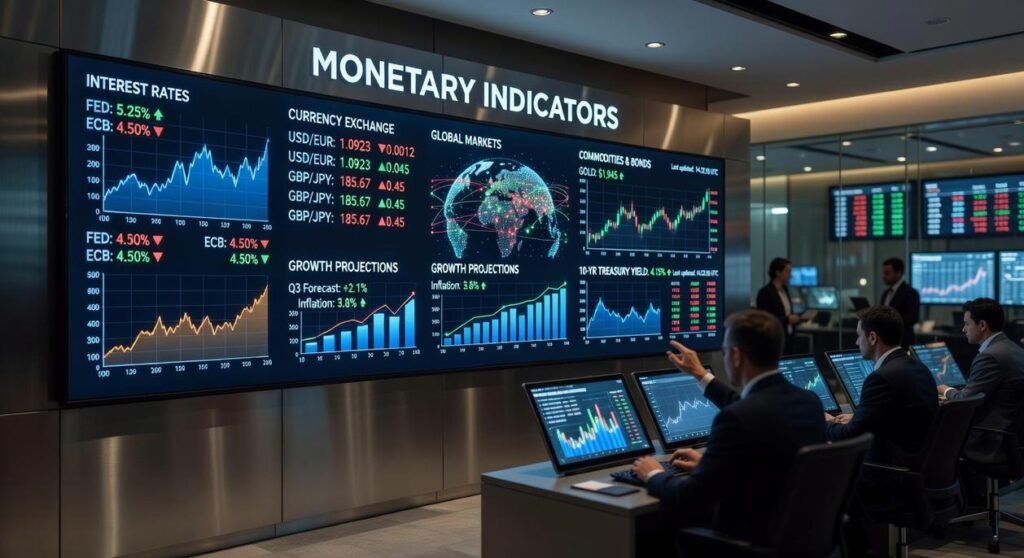
Foreign Exchange (Forex) Rates act as a real-time scorecard. When USD/JPY surges, it often signals capital seeking dollar safety; when USD/CNY weakens, it can reflect policy easing or growth concerns. On trading floors, screens glow red or green as asian market performance indicators adjust in sync with these currency swings.
• Government Bond Yields: The yield curve—short-term versus long-term rates—reveals market expectations. An inversion, where short-term yields exceed long-term ones, has preceded recessions in the U.S. and parts of Asia (Federal Reserve data). It feels subtle at first, like a faint metallic tang in the air, but seasoned investors recognize the warning.
Some argue bond markets overreact. Yet history suggests ignoring these signals can be costlier than heeding them.
Trade Flows and Geopolitical Barometers
Trade Balance (Exports vs. Imports): A trade surplus—when exports exceed imports—adds directly to GDP, while a deficit subtracts from it (a simple equation with outsized consequences). China’s $823 billion trade surplus in 2023 strengthened the yuan’s resilience despite global slowdowns (China Customs data). By contrast, persistent U.S. deficits have weighed on long-term dollar dynamics. The Regional Comprehensive Economic Partnership (RCEP) is projected to add $186 billion annually to global income by 2030 (Petri & Plummer, 2020).
Foreign Direct Investment (FDI) Inflows: FDI reflects durable capital commitments.
- ASEAN attracted $230 billion in FDI in 2022 (UNCTAD).
- Vietnam’s surge signals supply-chain realignment.
These shifts often precede movements in asian market performance indicators.
Now that you have the tools, the real work begins. Instead of skimming headlines, start connecting macro trends, consumer behavior, and policy shifts into one clear storyline. For example, if export growth slows while domestic spending rises, that tension signals sector rotation, not collapse. By cross-checking inflation data, trade flows, and liquidity moves, you turn asian market performance indicators into practical foresight.
You might ask, where should I begin? First, map quarterly GDP against central bank guidance; then layer retail sales and credit expansion. Pro tip: track revisions, not just initial releases. Over time, patterns emerge before consensus catches up.
Stay Ahead of the Shifts Shaping Asia’s Economic Future
You came here to gain clarity on where Asia’s economy is heading—and now you have a sharper understanding of the forces driving regional growth, trade realignments, and policy shifts. From evolving trade agreements to monetary pivots across the Asia-Pacific, the landscape is moving fast, and staying informed is no longer optional.
The real challenge isn’t access to information—it’s knowing which signals matter. When asian market performance indicators shift, capital flows, investor confidence, and cross-border opportunities can change overnight. Missing those signals can mean missed growth, misallocated capital, or strategic blind spots.
Act now by consistently tracking reliable regional data, monitoring policy updates, and aligning your strategy with forward-looking forecasts. Don’t wait for headlines to react—use them to prepare.
If you want timely Horizon Headlines, in-depth regional analysis, and trusted economic forecasts that help you stay ahead of volatility, start leveraging our expert insights today. Stay informed, stay strategic, and position yourself where Asia’s next wave of opportunity is forming.